
GoodHood
Expanding community through home services in Millennials
Role: Project Timeline:
UX Research 5 weeks
UX Design 4 Sprints
Project Management 2 Phases User Testing
The Project
The home services industry is worth billions, but millennial homeowners and renters alike report difficulty in finding reliable and affordable contractors that return on the value they promise. Compounded by a seemingly ubiquitous lack of millennial DIY knowhow, this is a problem that has long led to frustration and headache for homeowners and renters.
The Challenge
The client seeks to build a home services digital platform that connects millennial renters and homeowners to local home service professionals. The client suggests that Millennial homeowners and renters alike want a one-stop solution for finding, reviewing, bidding, scheduling and paying for home services while also finding reliable and affordable contractors. They seek a central database that cuts costs and provides transparent, flat rates through cashless transactions.
Our team would be focusing on:
The consumer side of the platform,
To assess the full end-to-end customer journey
To consider ways to increase user engagement on various devices
Breaking down the problem: start by establishing assumptions.
The client’s assumes that Millennials don’t know how to DIY— unable to do home service tasks themselves.
Millennials are seeking cashless transactions in a digital realm.
Millennials are seeking a one-stop solution for all home service needs.
Team Assumptions and Bias
Most Millennials are renters rather than homeowners, and these experiences and needs will differ
Millennials are extremely budget conscious in these decisions and seek affordable services rather than elite or quality services.
The Research *my favorite part.
The following research tools were chosen to:
Find gaps and opportunities in the market
Build the foundational exploratory qualitative and quantitative data of user needs and pain points.
Validate or Invalidate the client’s assumptions
Validate or Invalidate the team’s assumptions and biases
Exploratory Research
Objectives:
1. Familiarize with the Home Services industry
2. Identify opportunities, gaps and trends from secondary sources.
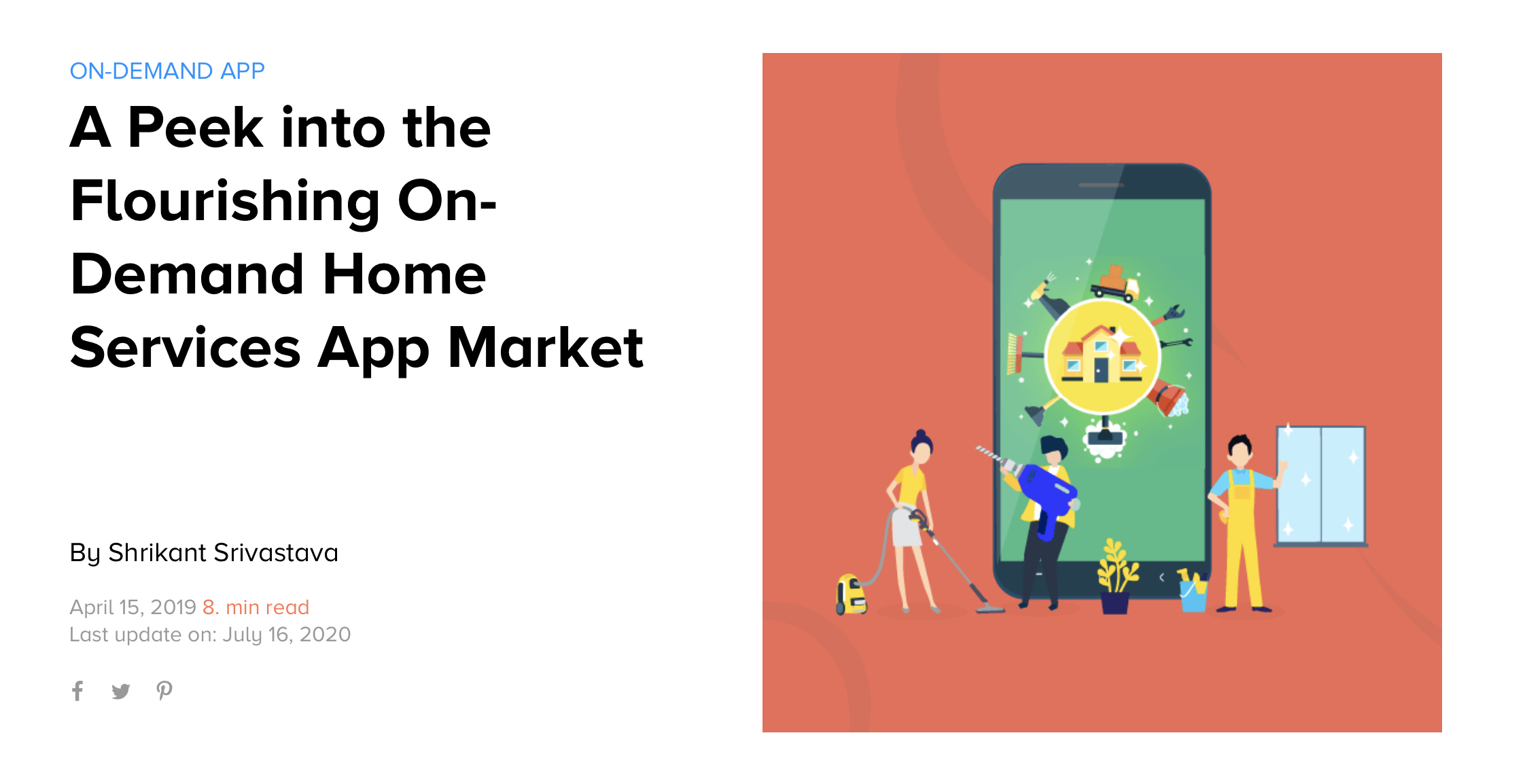
Exploring secondary sources, we identified opportunities, gaps and trends.
Opportunity: Suggested Platform:
Increased usage of smartphones in correlation with the rise of the home services industry, creating a mobile application would be the most appropriate
(Source: Appinventiv)
Gap: Lack of Pricing Standard
No standard of pricing for home services (remodeling, interior design, landscape)
Two common fees prevail Fixed + Estimate costs. Fixed also has hidden contingency fees (placed so that no-cost changes affect the cost of the project)
Opportunity: Establishing Transparency in Pricing
Consider providing upfront costs and ways to be as transparent as possible with pricing for home services.
Trend: Rise of the Millennial Home Owner
In 2018, Millennials represented the largest cohort of home buyers at 37%. (Source: Washington Post).
Competitive Analysis
Objectives:
Identify the current leaders in the digital home services space.
Explore their strengths and weaknesses.
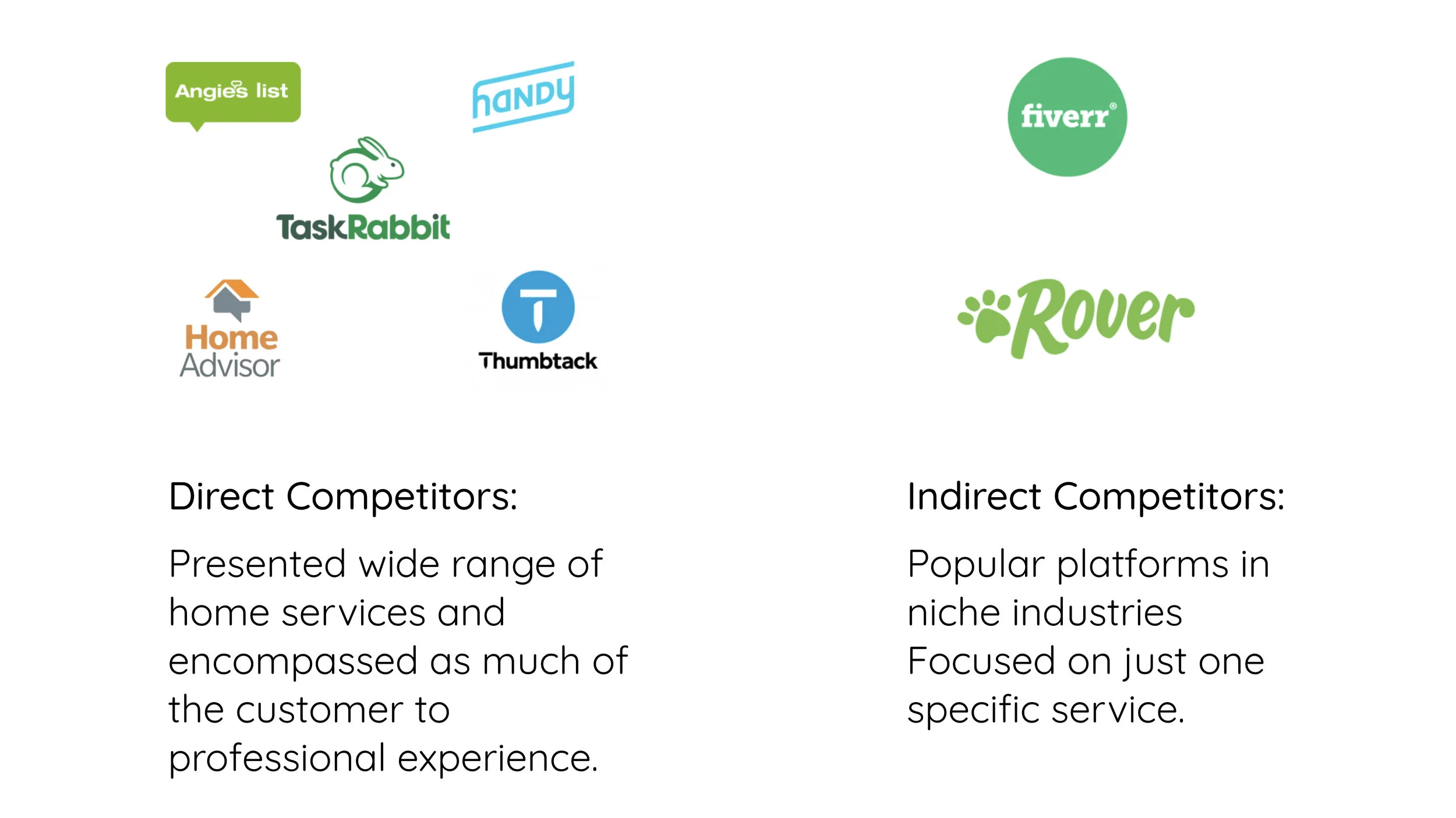
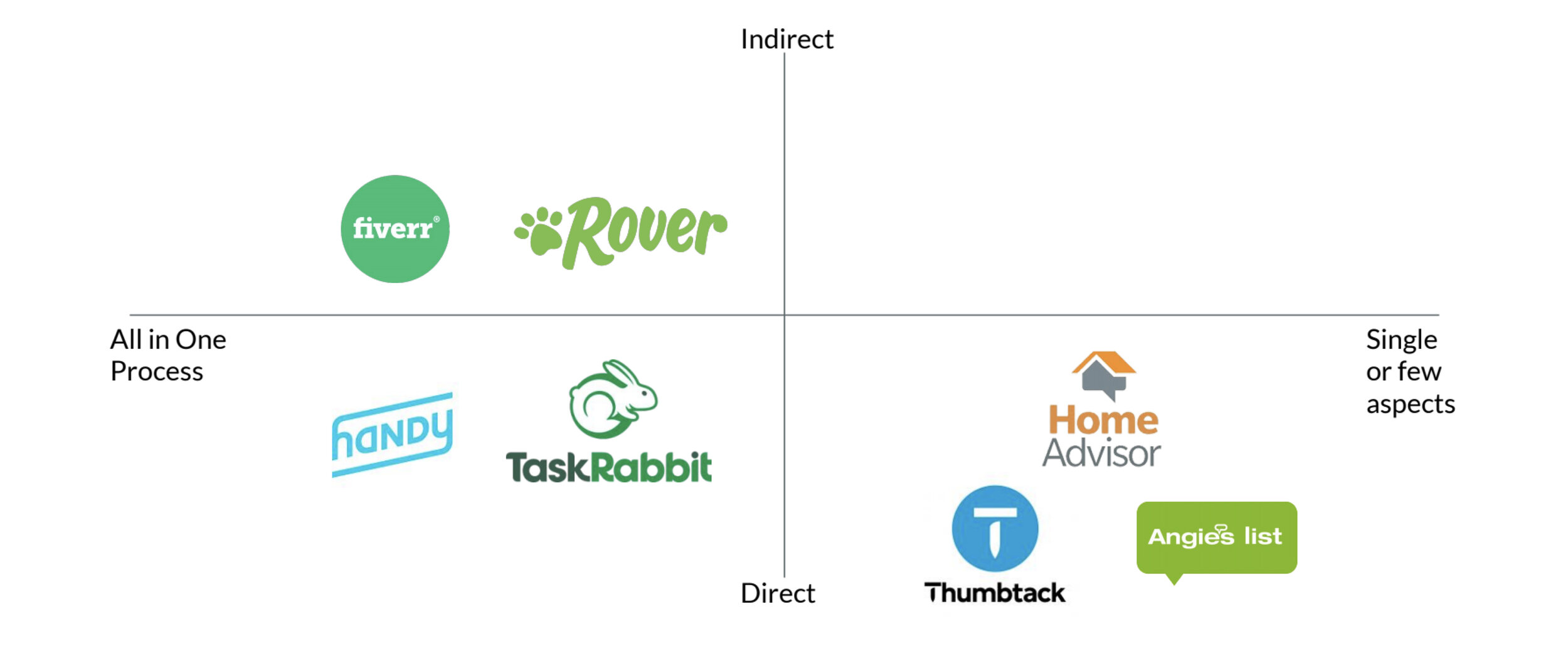
The matrix above presents the platforms that incorporate all aspects of the home service provider process: from searching, reviewing, communicating, tracking projects, and payment, in contrast to those that only integrate single or few aspects. This allowed us to evaluate the client demand of an ‘all-in-one’ platform.
User Interviews
Objective: to explore users’ needs, motivations, frustrations and behaviors and too further explore the key insights from the exploratory research and competitive analysis.
We interviewed 10 participants (5 homeowners + 5 renters) and constructed 2 scripts with specific questions targeted for each type.
The questions were divided in several parts:
Home Maintenance Questions (Renters + Homeowners)
Transactions with Home Service Professionals (Renters + Homeowners)
Home Improvement/DIY Questions (Homeowners)
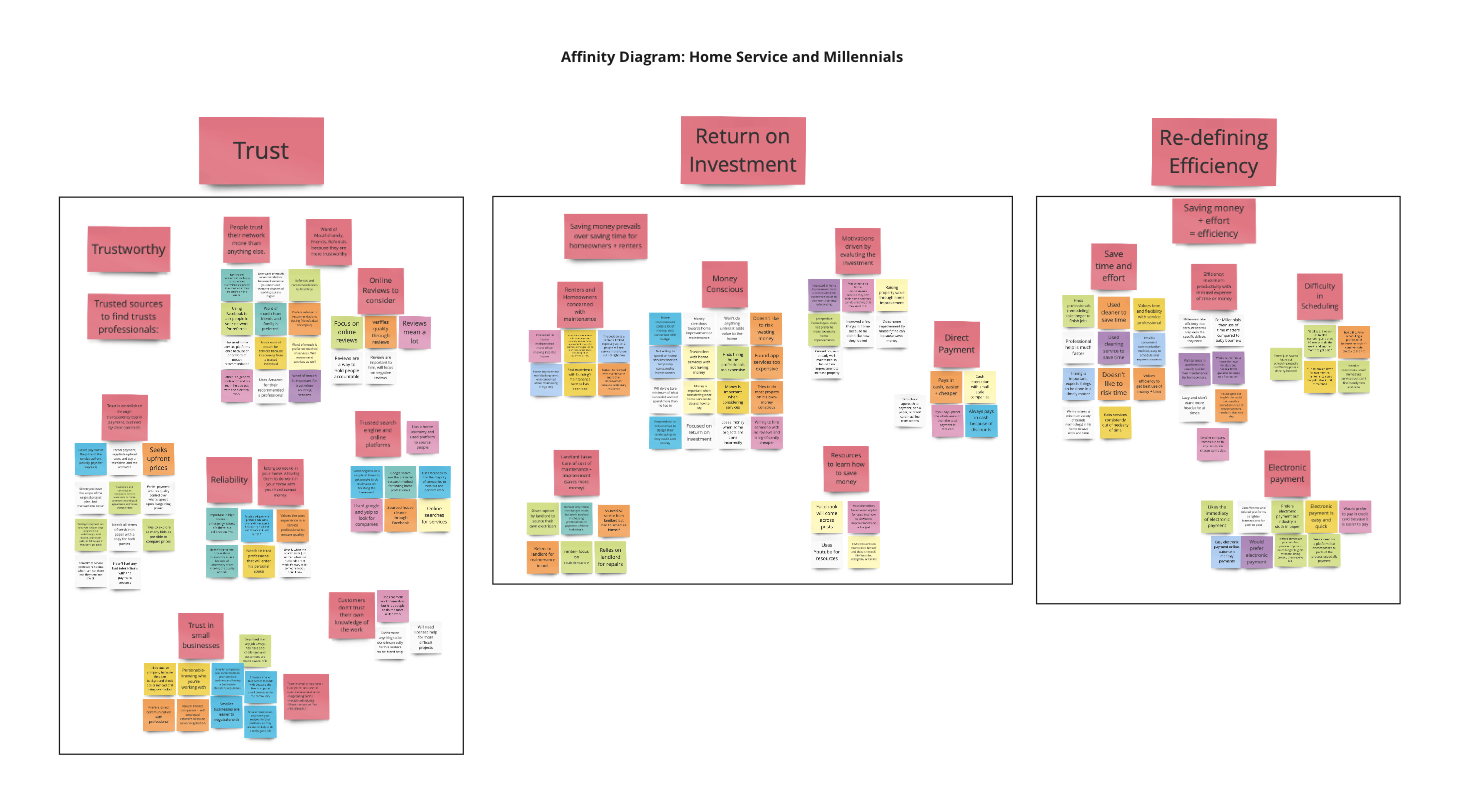
Through several rounds in Miro of Affinity Diagramming with qualitative insights we discovered a system of analyzing user thought processes when evaluating home service needs— for BOTH homeowners and renters.
Research Discoveries
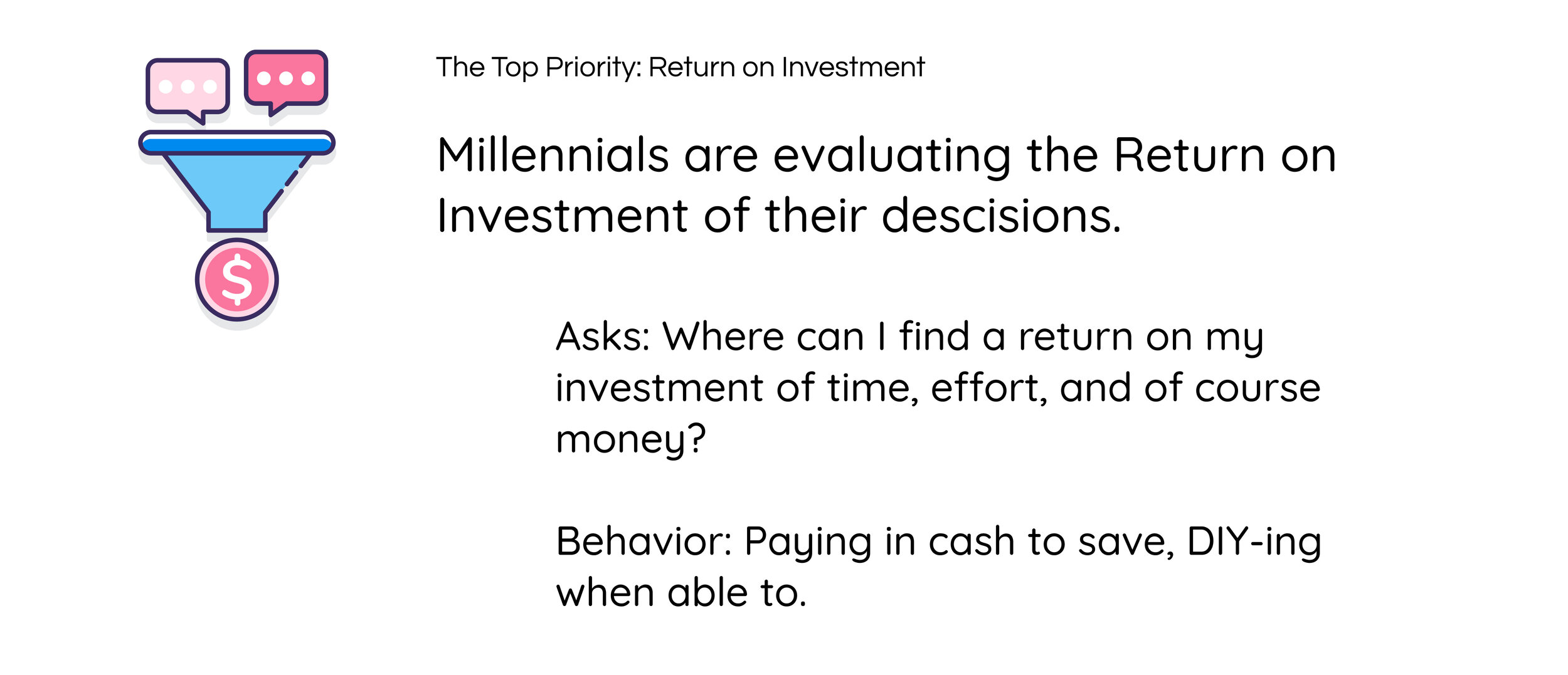
While evaluating the qualitative data, I noticed a series of patterns emerging which I took lead in categorizing into The Process of Evaluation’ pyramid and shared with my team.
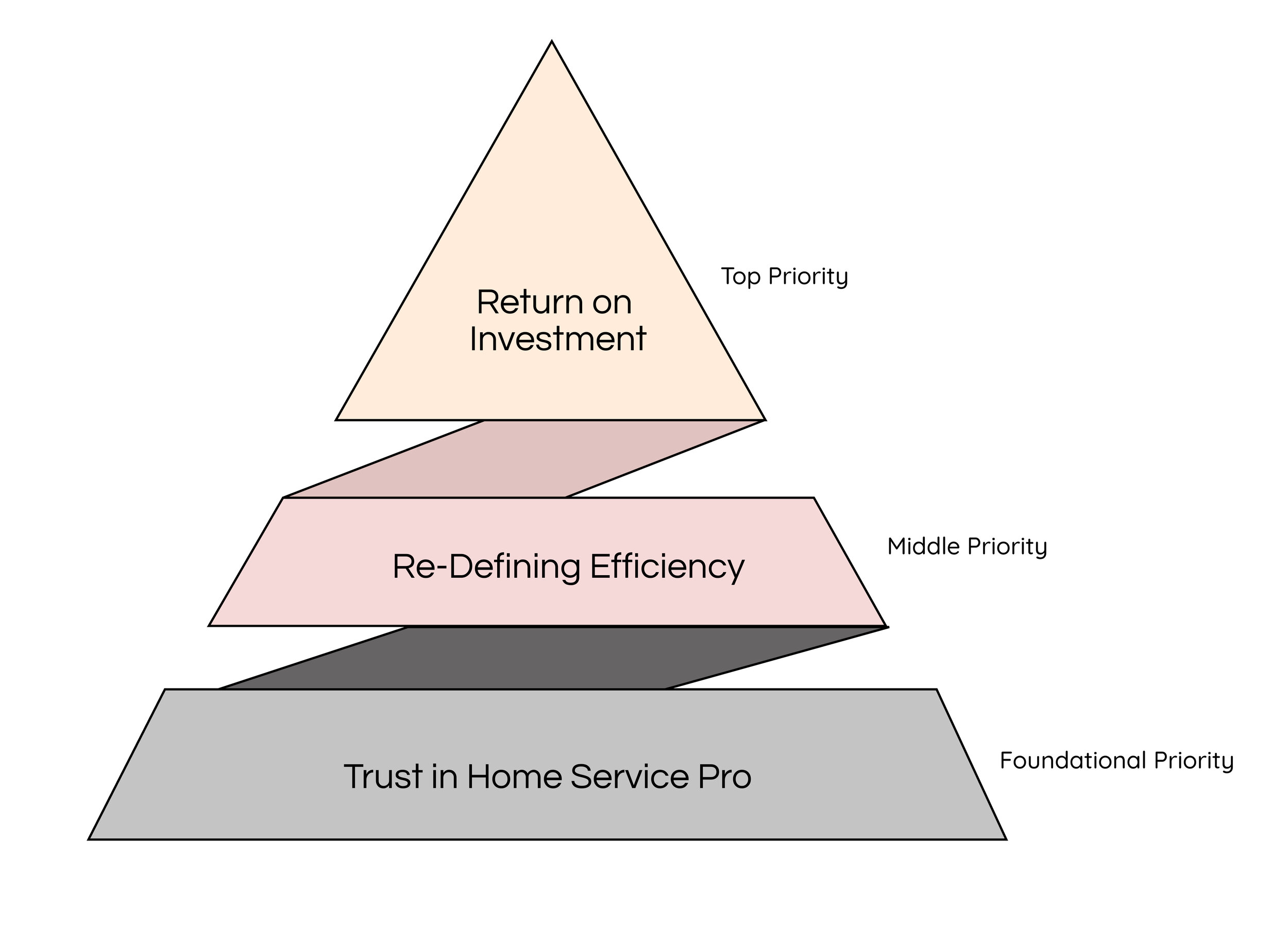
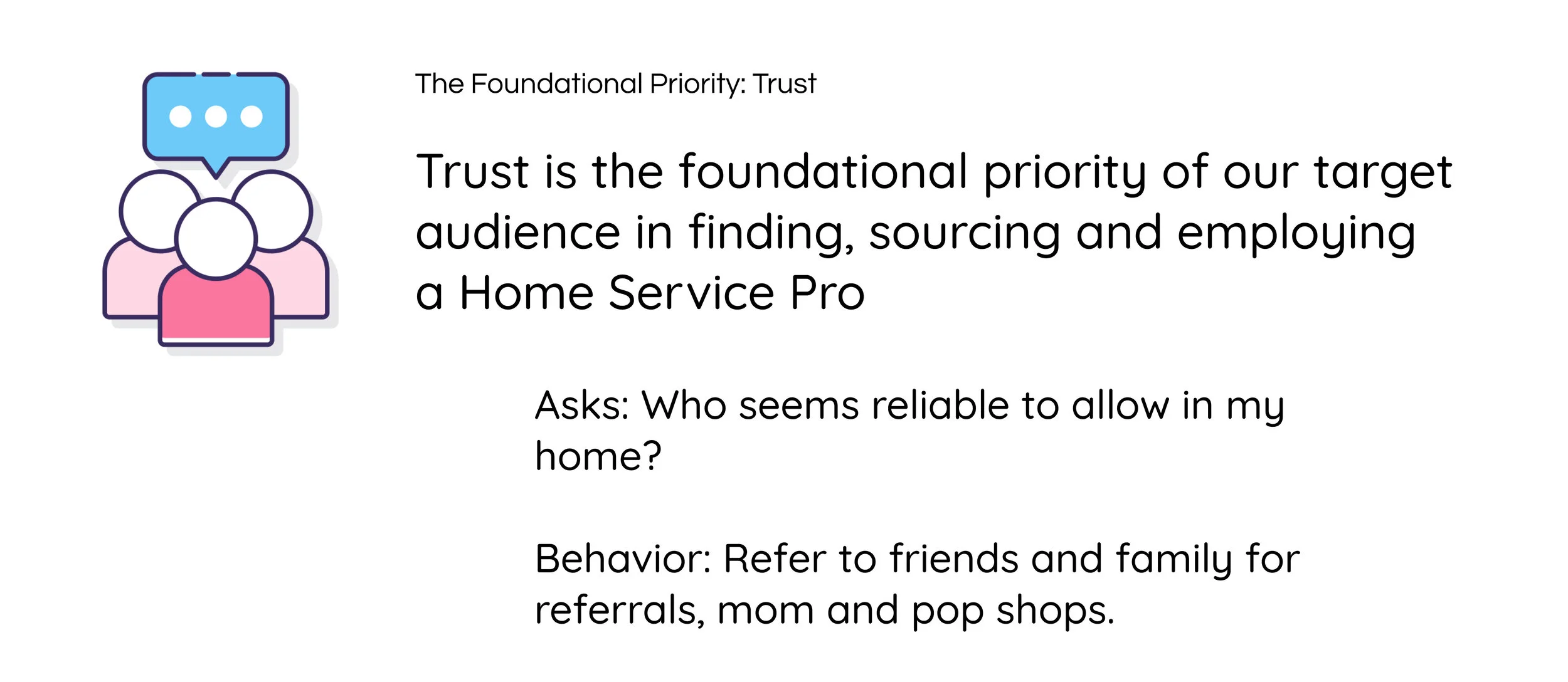
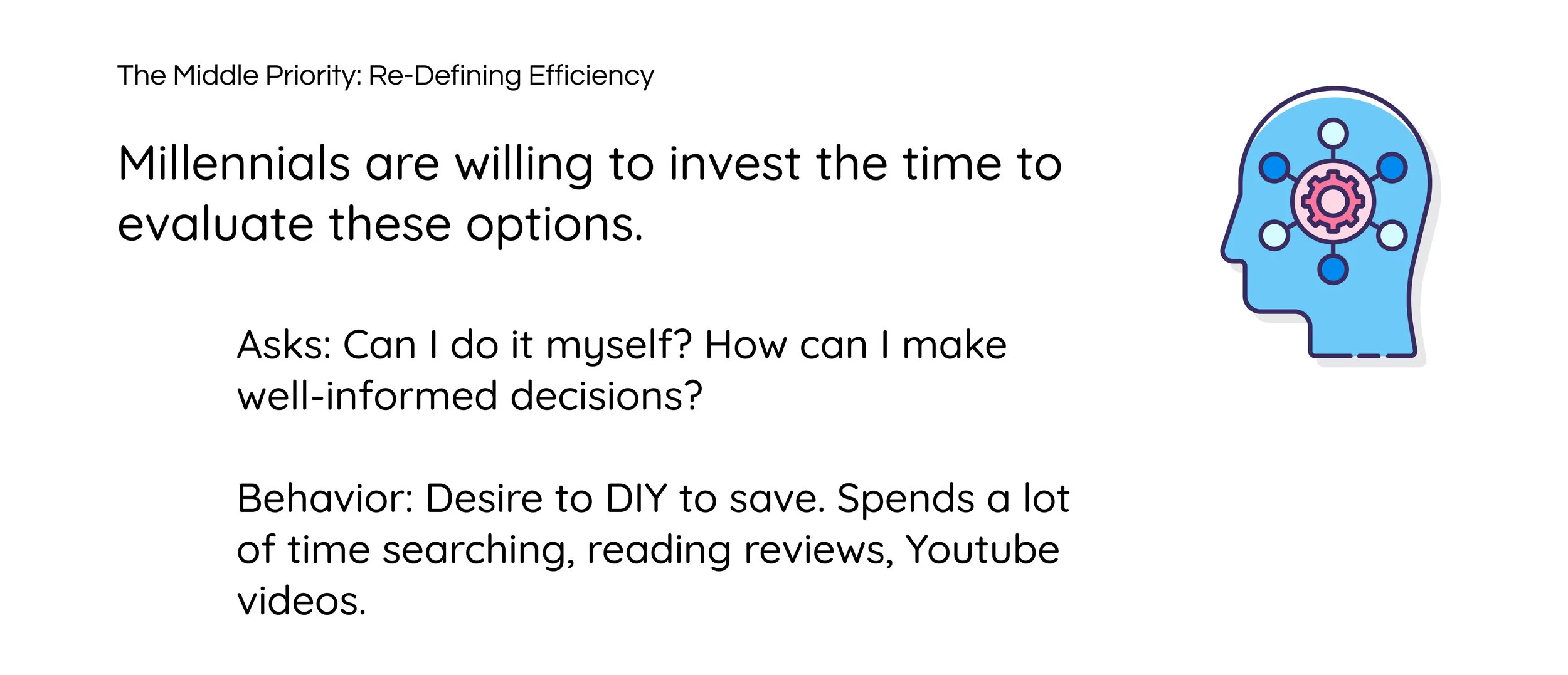
I found that by organizing the qualitative data in these three tiers, we could understand how Millennials are evaluating their decisions when it comes to both their home maintenance and improvement needs, and this can apply to both Homeowners and Renters, ebbing and flowing with any circumstance.
Target Persona
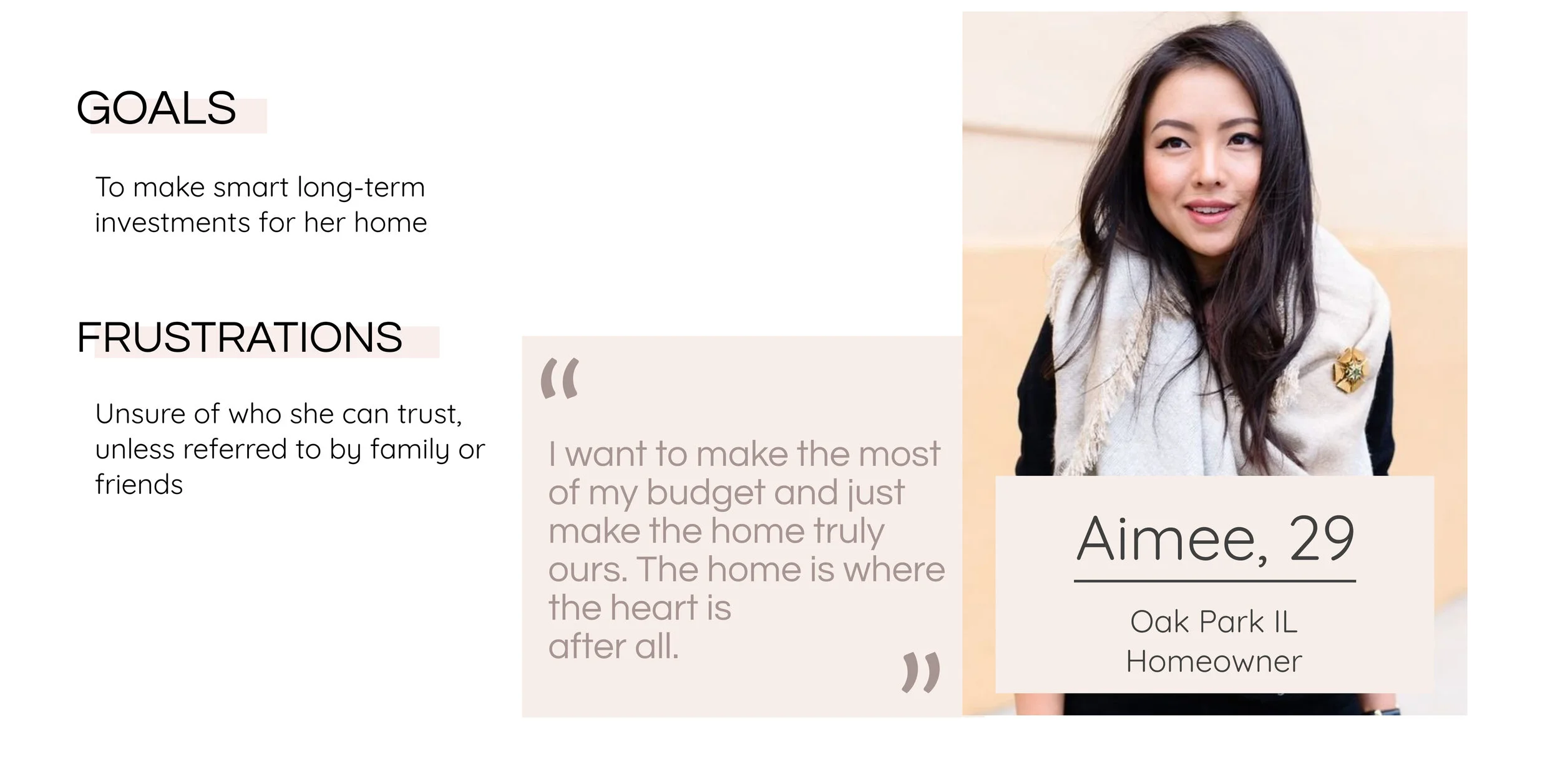
Leveraging our research insights we formulated a target persona.
Aligning on the Problem:
We shared our insights with the stakeholder and aligned on a precise Problem Statement:
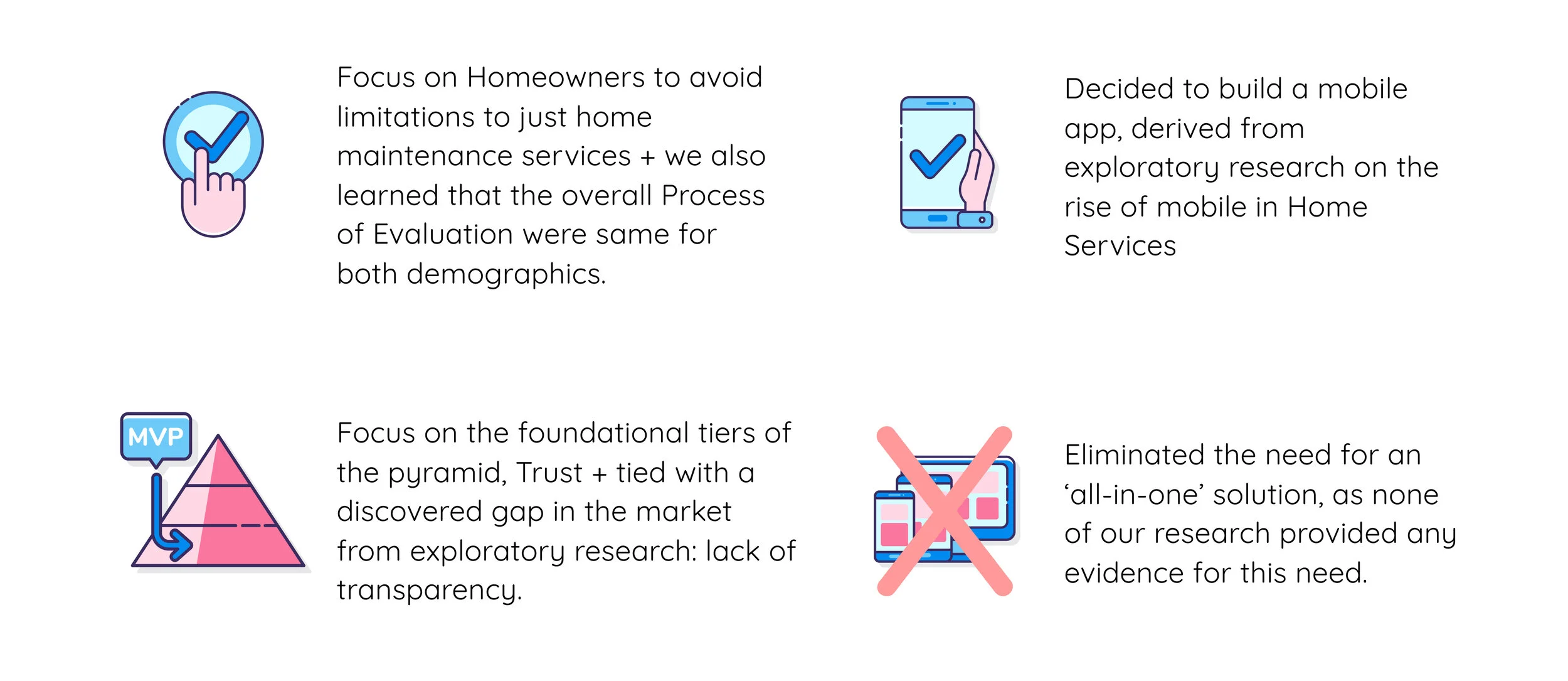
Market-informed Millennial homeowners and renters need a transparent and communicative tool that allows users to streamline the search of reliable professionals because they value making informed decisions and ‘word-of-mouth’ is lengthy and exhaustive.
To understand the problem further, we created a User Scenario Map, to guide us through our persona Aimee’s experience. We used the example of her process when finding an A/C Repair Professional.
Through this workshop, we discovered an interesting point in Aimee’s scenario. The most productive part of Aimee’s scenario was when she turned to her network (an insight we also found in our research). This workshop allowed us to start ideating solutions.
Ideating possible solutions
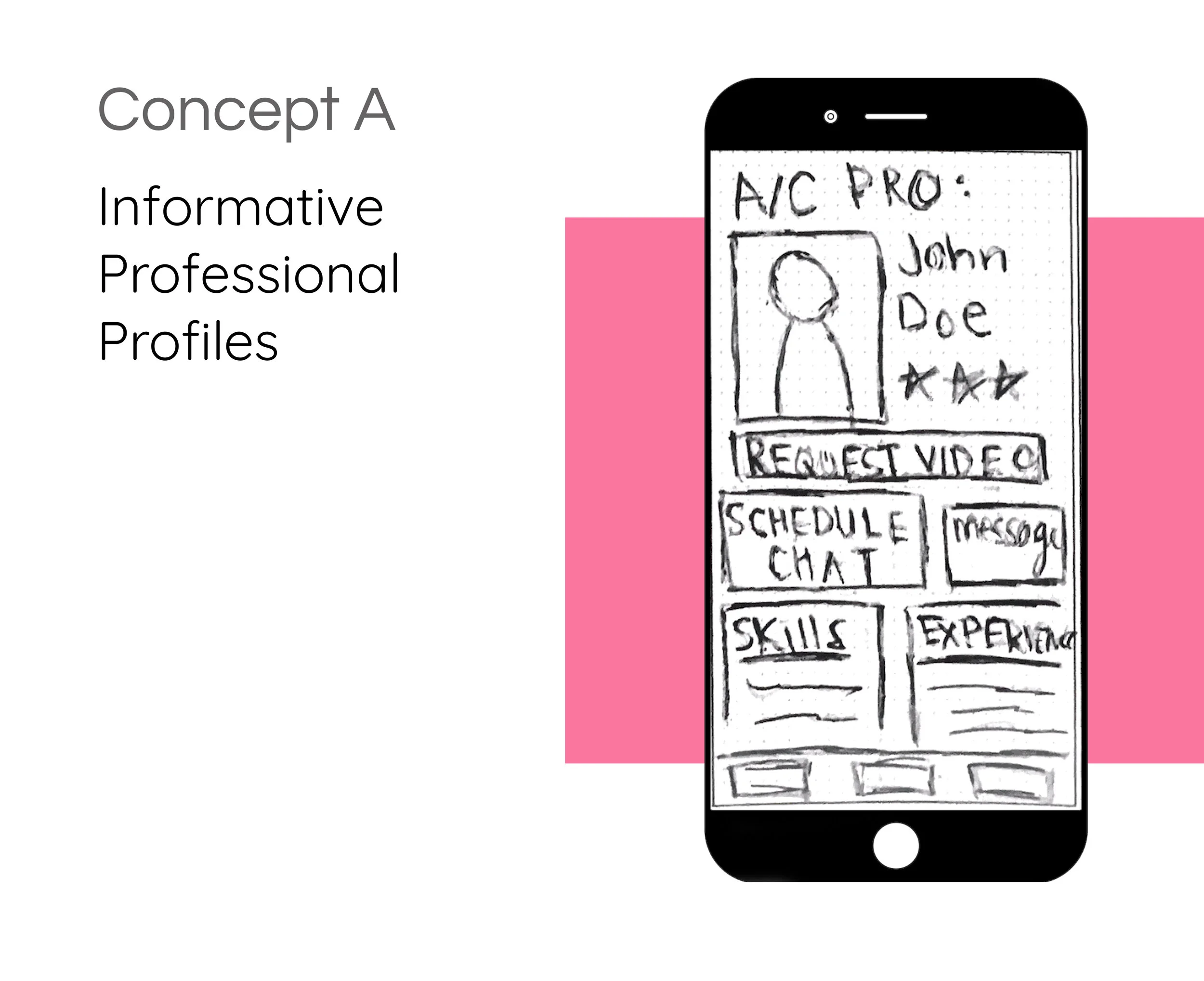
Concept A: inspired by telehealth, this concept allows users to find and immediately connect with local professionals via video chat. Through informative profiles and reviews of Pros, users can make informed decisions.
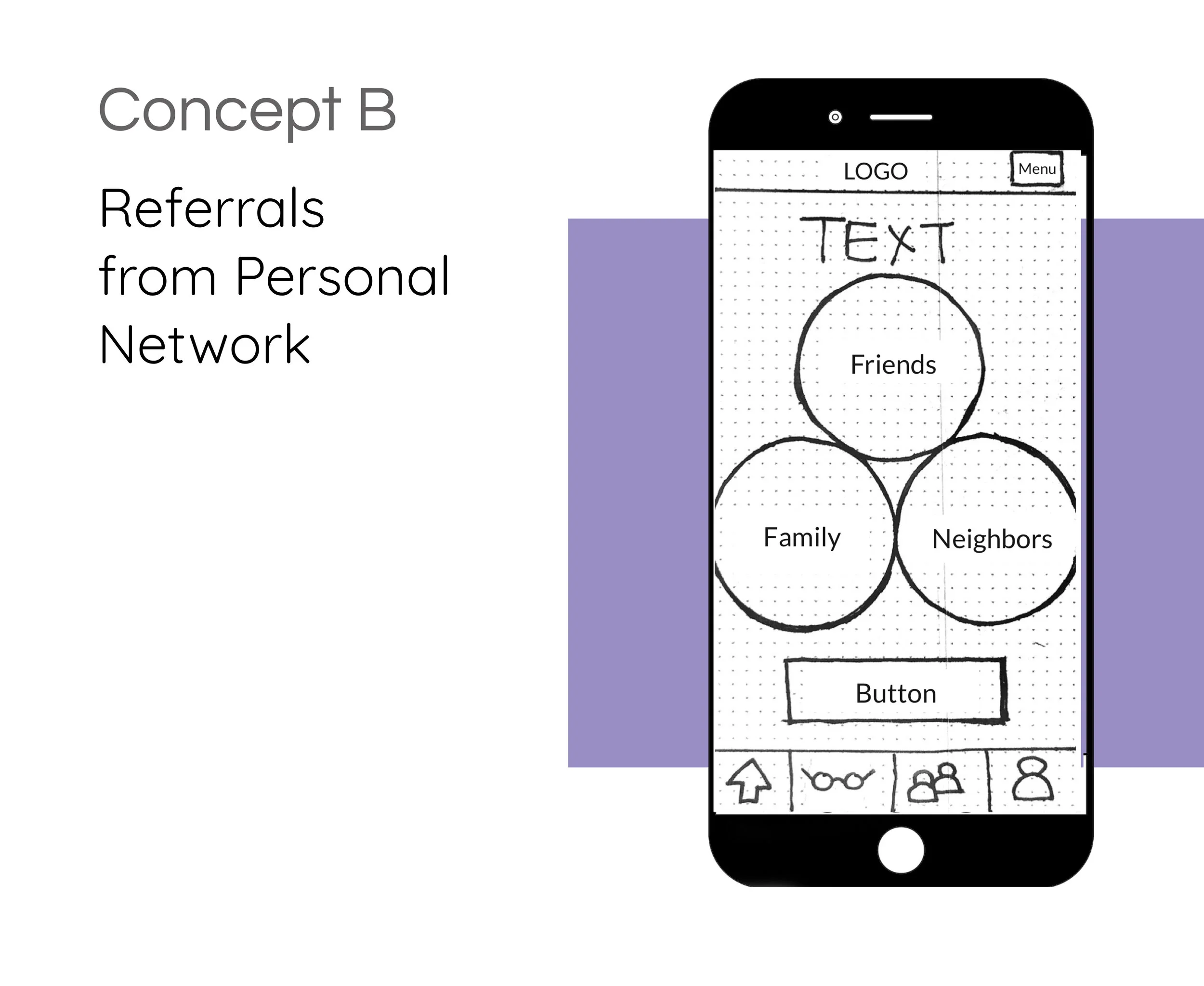
Concept B: This concept allows users to connect with their friends, family, and neighbors and assess recommendations based on this internal network. Users can find trusted Pros without the tedious process of asking around.
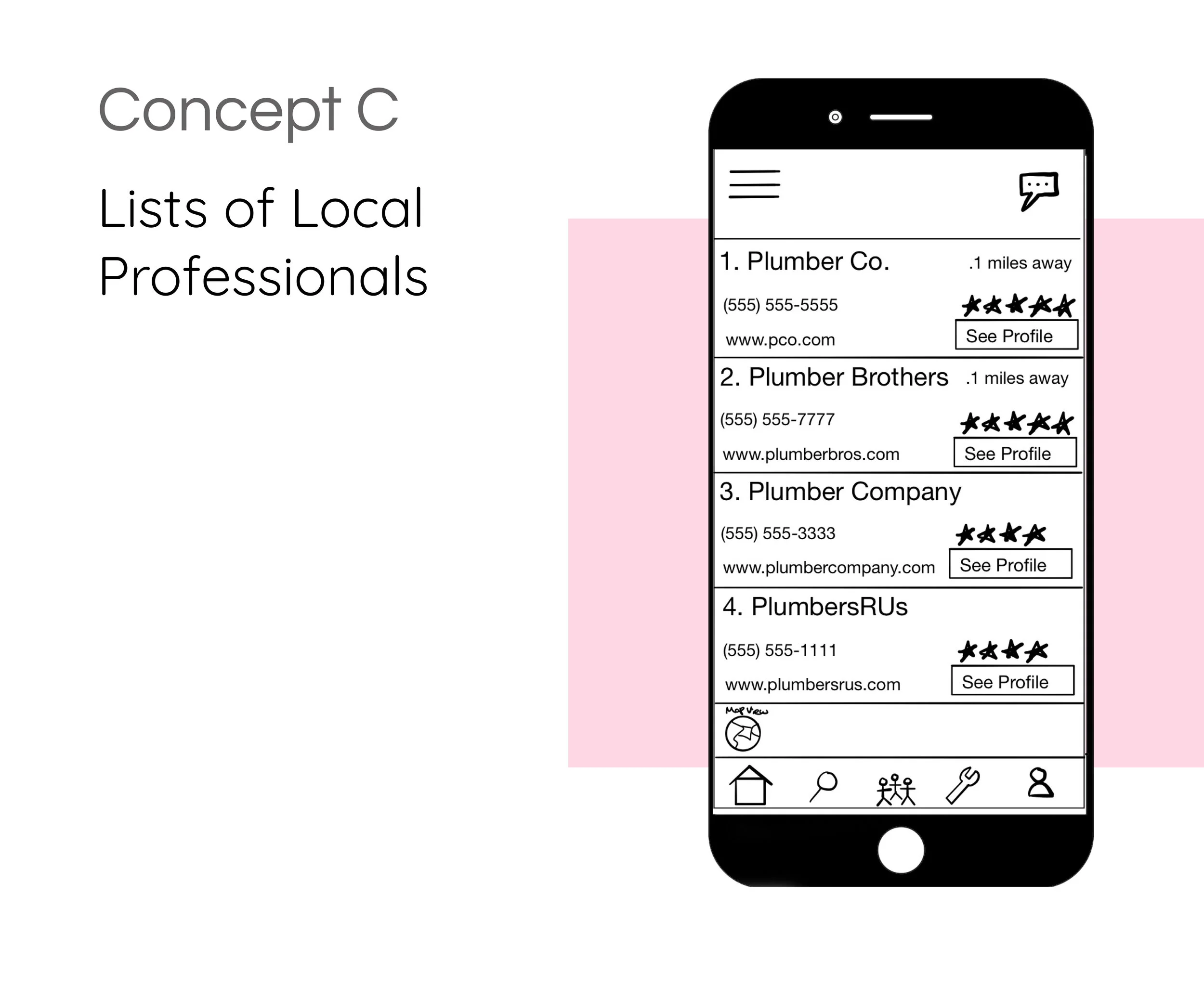
Concept C: Uses geography to connect with local professionals featuring a map and list views. This concept also features a community element where local users in the neighborhood (zipcode) share home services projects and offer support to others.
Convergence for a final design
We assessed the components through a SWOT analysis and assesed the strengths of each concept in a Prioritization Matrix. According to the client’s needs with evaluated based on User Value and technical Feasbility.
We eliminated all components that had low user value and feasibility. And prioritized all components that had High user value and high feasibility.
Over a series of Charrettes, we implemented the design components that scored highly on our prioritization matrix into a low-fi design.
Usability Testing on Mid-Fidelity Design
We conducted Usability Testing on 6 participants,
4 homeowners + 2 Renters.
Objectives:
Qualitative: Assess Usability:
Observe user behavior when conducting task
Observe alternative paths user may take
Observe frustrations
Quantitative: Efficiency
Number of errors
Task Completion rate
Iterating rooted in Usability Testing Outcomes.
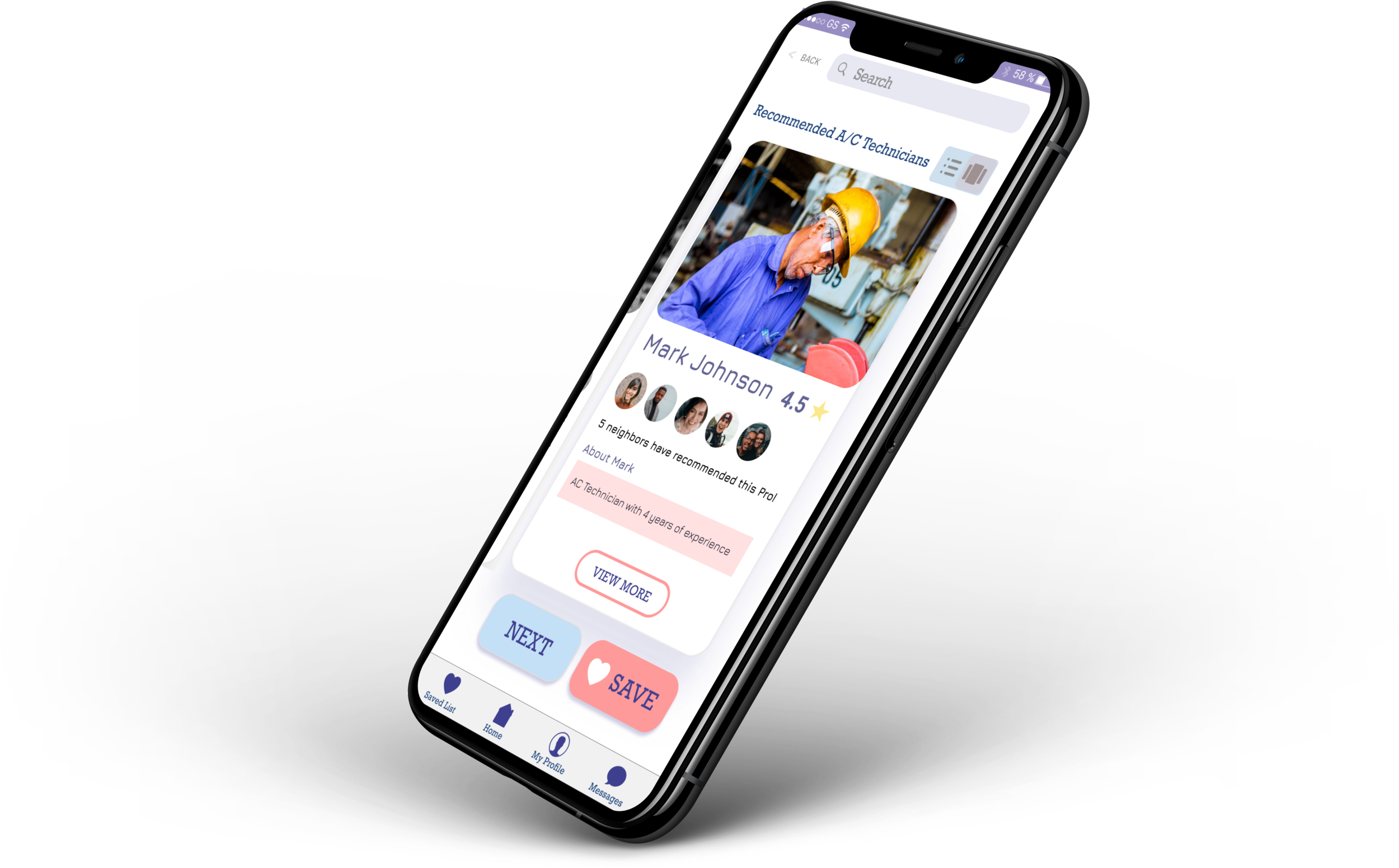
In the interest of time, we made minor iterations based on the results of Usability Testing. We prioritized the save button from Version 1 to Version 2 because Users found this button difficult to find and misunderstood the placement.
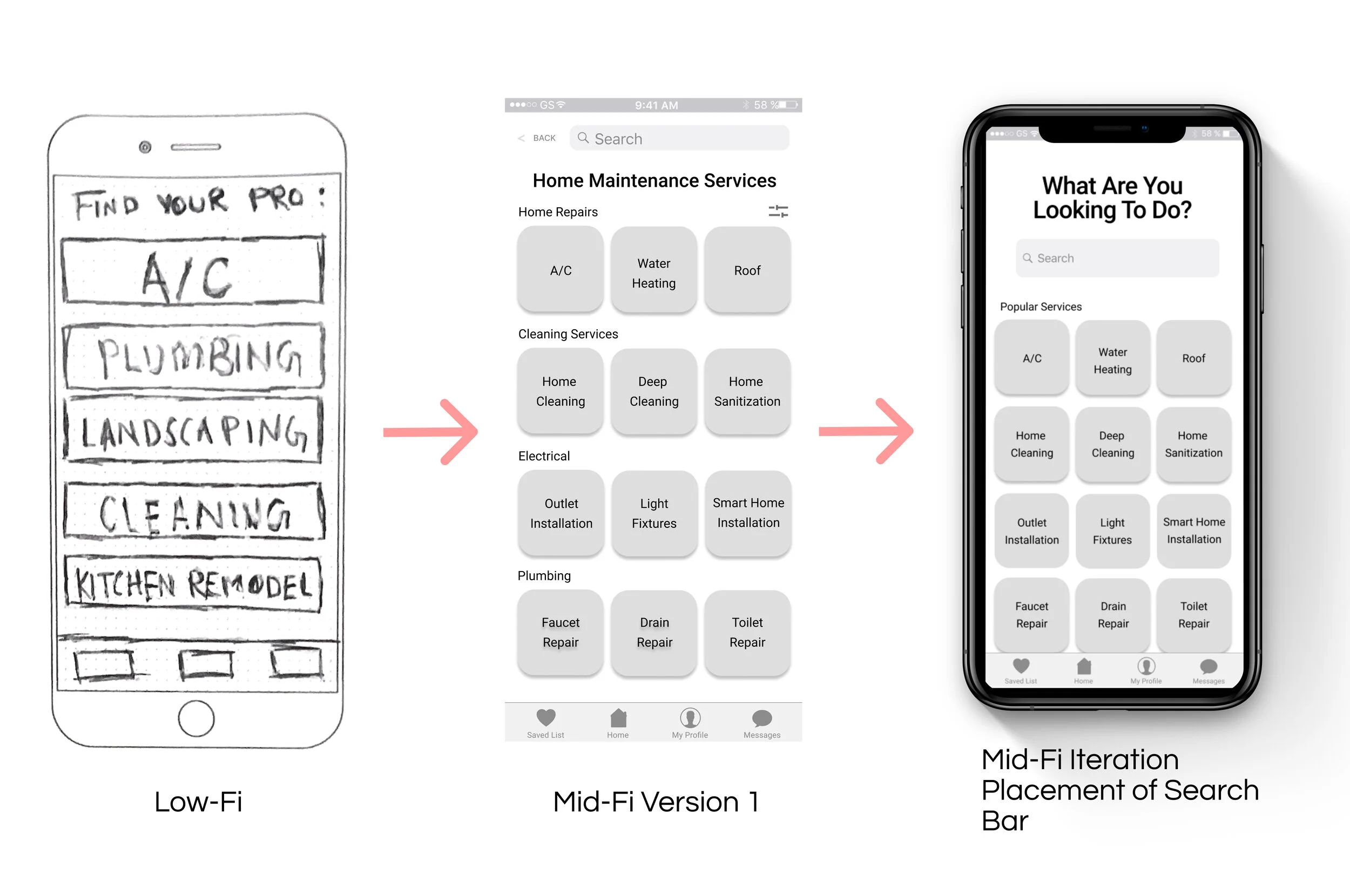
We prioritized the search bar from Version 1 to Version 2 for efficiency. We observed that Users' first instinct was to search for a category when asked to find an A/C professional despite the accessibility of A/C option.